
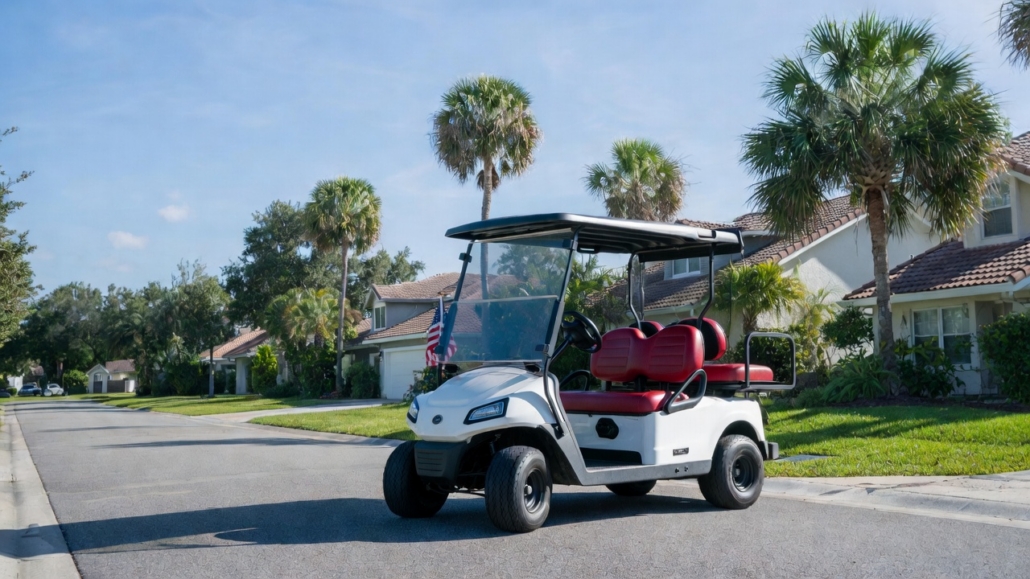
Golf Cart Friendly Neighborhoods In Vero Beach
Golf Cart Friendly Neighborhoods in Vero Beach: Where Can You Legally Drive One?
- Golf carts are only legal on public streets in Vero Beach where the city has specifically designated them, and right now that means two zones: the streets around Riomar on the barrier island and the streets around Vero Beach Country Club on the mainland.
- Everywhere else, the golf cart lifestyle lives inside private communities like John’s Island, The Moorings, Grand Harbor, Windsor, and Pointe West, where carts run on private streets the city ordinance doesn’t touch.
- The city requires a valid driver’s license and limits carts to designated streets with speed limits of 30 mph or less, between sunrise and sunset.
- A street-legal LSV (low-speed vehicle) is a different animal from a golf cart: it needs a title, registration, insurance, and a licensed driver, but it can go places a plain golf cart can’t.
- If a cart-first lifestyle is a must-have for your move, tell your agent up front, because it narrows the neighborhood list more than most buyers expect.
Buyers ask me about this more than you’d think. Somebody visits from Ohio or New Jersey, sees a couple pulling up to Village Beach Market in a golf cart with a dog riding shotgun, and decides that’s the version of Florida they want. Fair enough. It’s a great version.
But here’s what the Instagram photo doesn’t tell you: in Vero Beach, where you can legally drive that cart is tightly defined. Some neighborhoods are genuinely built for it. Some tolerate it on private streets behind a gate. And on most public roads in the city, driving a golf cart is illegal, full stop. So before you buy the house and then the cart, let’s go through where the golf cart life actually works.
First, the rules (because they decide everything)
Florida law generally prohibits golf carts on public roads unless a local government specifically designates streets for them. Vero Beach has done exactly that, and the city’s rules are stricter than the state’s baseline.
Inside Vero Beach city limits:
- Golf carts are only allowed on specifically designated city streets with posted speed limits of 30 mph or less
- You need a valid driver’s license to operate one
- Carts can run sunrise to sunset only, no night driving
- The city ordinance takes precedence over state law because it’s more restrictive
Then there’s the state layer. Florida’s HB 949, effective July 2023, requires anyone under 18 to hold at least a learner’s permit to drive a golf cart. And vehicles with top speeds between 20 and 25 mph are classified as low-speed vehicles (LSVs), which must be titled, registered, and insured, and can only be driven by licensed drivers on roads with speed limits of 35 mph or less.
That golf cart vs. LSV distinction matters when you’re shopping. A basic golf cart is cheaper but confined to designated streets and private communities. A street-legal LSV with headlights, mirrors, seatbelts, and a VIN opens up more roads, but it comes with registration and insurance obligations like a car.
The two public-street golf cart zones in Vero Beach
The city has designated roughly 20 streets on the island plus a cluster on the mainland where golf carts are legal on public roads. If cart-to-the-store freedom on public streets is the dream, these are the neighborhoods.
Riomar and the surrounding Central Beach streets
This is the heart of Vero’s golf cart culture. Riomar is the historic barrier island neighborhood wrapped around Riomar Country Club, and the city allows carts on portions of Bay Oak, Flamevine, Gayfeather, Greenway, Hibiscus, Iris, Ladybug, Painted Bunting, Sandfly, Seagrape, and Tulip lanes, plus Bay, Cardinal, Club, Cove, Eagle, Ocean, River, and Riomar drives.
Practically speaking, that means you can live in Riomar or the adjacent Central Beach streets and cart to the club, to friends’ houses, and toward the Ocean Drive area. The city’s 2024 ordinance update also expanded access for residents near Village Beach Market via the sidewalk route on the west side of A1A to the Jaycee Park pedestrian crossing, which stitched the neighborhood cart network together in a way it wasn’t before.
This is also, not coincidentally, some of the most desirable non-gated real estate in Vero. Old Riomar homes trade well north of $2 million, and Central Beach runs a wide range depending on street and condition. You’re paying for location either way. The cart access is a bonus that happens to overlap with the best walkable beach living in town.
The Vero Beach Country Club district (mainland)
The city’s 2024 expansion added the original golf neighborhood on the mainland: the streets around Vero Beach Country Club. Carts are allowed on sections of Anita Avenue; Country Club, Fairway, Laurel, and Paloma drives; Coronado and Whippoorwill lanes; and Catalina, 26th, and 25th streets.
This is old Vero. Mid-century homes, big oaks, no HOA, and a genuine cart-to-the-clubhouse culture that existed informally for decades before the city made it official. Price-wise it’s a fraction of the island: you can still find homes here in the $400,000s to $700,000s depending on size and updates, which makes it the value play on this entire list. If you want legal public-street cart life without island money, this is the neighborhood.
Private communities where the cart life thrives behind the gate
The city ordinance only governs public streets. Private communities set their own rules on their own roads, and several of Vero’s best-known communities are functionally golf cart neighborhoods even though you’ll never see a city sign about it.
John’s Island. Carts are woven into daily life here. Members cart between home, golf, the beach club, and tennis on private roads and paths. If you’re shopping at this level, cart access is simply part of the package.
The Moorings. Boating first, but the private streets are quiet and cart traffic to the club is normal. Same story at Windsor and Orchid Island further north: private roads, club-centered life, carts everywhere. One note for Indian River Shores communities: carts can’t touch A1A itself because the speed limit is 45 mph, so cart life stays inside each community rather than connecting between them.
Grand Harbor. On the mainland side of the lagoon, Grand Harbor’s scale actually makes a cart useful: two golf courses, a marina, tennis, and a beach club shuttle point spread across a big footprint. Plenty of residents run a cart as the default second vehicle inside the gates.
Pointe West. The sleeper pick on this list. Pointe West is a traditional neighborhood design community in west Vero: front porches, sidewalks, rear-alley garages, four villages wrapped around a private golf course, and an HOA with an actual written golf cart policy. It’s one of the most genuinely cart-friendly everyday neighborhoods in the county, and homes here cost far less than anything on the island. For families and active retirees who care more about using the cart daily than about being near the ocean, it’s hard to beat.
What to check before you buy the house (or the cart)
A few things I walk buyers through when the golf cart is part of the plan:
- Confirm the specific street. The city designations are street-by-street and even section-by-section. Two blocks over can be the difference between legal and ticketed. Pull the current city map before you fall in love with a house.
- Read the HOA docs. Private communities regulate carts too: registration with the HOA, age rules, where carts can park, sometimes charging requirements. Pointe West publishes its policy; most gated communities have one.
- Decide cart vs. LSV early. If you want to cross or ride along bigger roads, you need a registered, insured LSV and the roads still need to be 35 mph or under. If you’ll stay inside a community or the designated zones, a standard cart is fine.
- Think about storage and charging. Older Central Beach and country club district homes weren’t built with cart garages. Newer communities often were.
Where golf cart friendly neighborhoods in Vero Beach fit into your bigger decision
The golf cart question is really a lifestyle-radius question: how much of your daily life do you want reachable without a car? If the answer is “most of it,” you’re choosing between Riomar/Central Beach money, the country club district value play, or a gated community where the radius is the community itself. If you’re still getting oriented on the town as a whole, start with where Vero Beach sits and the full relocation guide, then come back to this list once you know your budget and your beach-versus-mainland lean.
Want the current cart-legal street map and real listings to match?
I’m a licensed Florida real estate agent based in Vero Beach, and I keep up with the city’s golf cart designations because buyers ask me about them constantly. Tell me your budget and how central the cart is to your plan, and I’ll send you actual listings in the neighborhoods where it works, along with the current street map so there’s no guessing. Reach out through my website or the contact page and we’ll figure it out.


Leave a Reply
Want to join the discussion?Feel free to contribute!