
The Most Expensive Communities In Port St. Lucie (2026 Guide)
What Are The Most Expensive Communities in Port St. Lucie?
- Port St. Lucie’s most expensive communities are Tesoro Club, PGA Village (especially Sabal Creek), the upscale enclaves inside Tradition, Astor Creek Golf and Country Club, Rivella, and a handful of riverfront pockets along the St. Lucie River.
- The sticker price is not the real number. Several of these communities carry CDD bonds, mandatory club memberships, or both, and that can add hundreds to over a thousand dollars a month on top of your mortgage.
- New construction dominates the high end here, which is great for buyers who want turnkey but means you should read the builder contract and the CDD disclosure carefully.
- Port St. Lucie luxury still runs well below comparable Vero Beach island communities, so if you are shopping the top of this market, it’s worth driving 30 minutes north before you commit.
- I work the whole Treasure Coast, so this list is ranked by what buyers actually pay and live with, not just by listing photos.
If you searched for the most expensive communities in Port St. Lucie, you probably found a few posts that list the same five neighborhoods, call each one “opulent,” and never tell you what it costs to actually live there. I want to fix that. I sell across the Treasure Coast, Port St. Lucie included, and the questions buyers ask me are never “which one has the nicest clubhouse.” They ask what the dues run, whether there’s a CDD bond hiding in the price, and which community fits how they actually want to spend a Tuesday. So that’s how I’m going to break this down.
How I ranked these (and why “expensive” is not just the list price)
“Expensive” in Port St. Lucie comes from three places, and you need to look at all three.
The first is the home itself, the price you see on the listing. The second is the CDD bond, which is a community development district assessment that pays off the infrastructure (roads, utilities, drainage) the developer put in. A lot of Port St. Lucie’s master-planned communities have one. It shows up on your tax bill, it can run anywhere from a few hundred to a couple thousand dollars a year, and it is on top of your regular property taxes. The third is club and HOA dues, which in the golf communities can include a mandatory membership with an initiation fee plus monthly dues.
Two homes with the same list price can cost very differently to own once you add those layers in. That’s the part the other guides skip, and it’s the part that actually decides your monthly number. I’ll flag it for each community below.
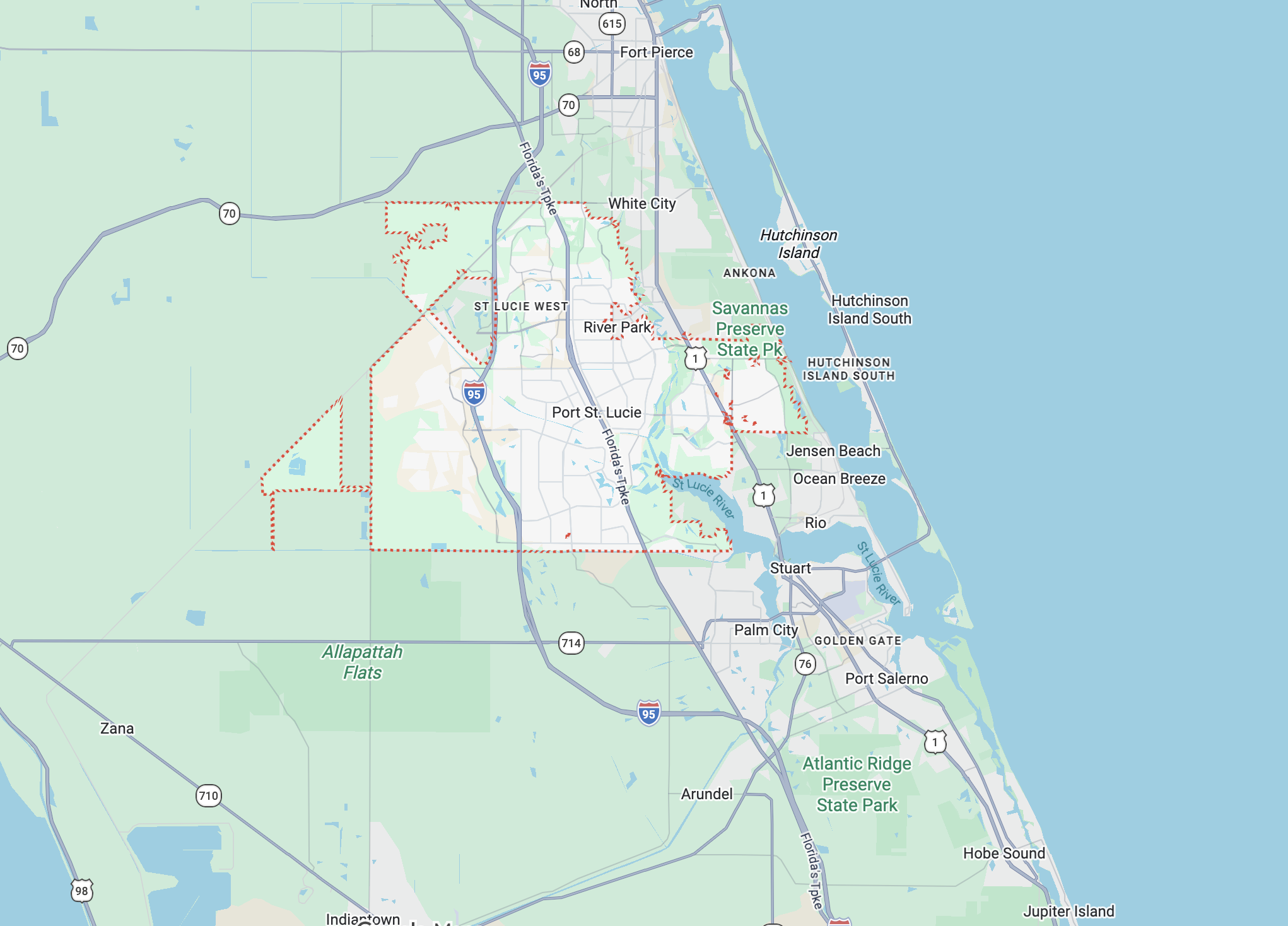
Where is Port St. Lucie on the map of Florida? This should help you visualize it.
Tesoro Club
Tesoro is usually the first name anyone says when they talk about luxury in Port St. Lucie, and that reputation is earned. It’s a large gated golf community off I-95 with a renovated clubhouse, two championship courses (the Palmer and Watson names get mentioned a lot), a racquet center, a spa, and a resort pool. The homes lean toward custom estates and luxury villas with Mediterranean and Florida contemporary styling.
What it actually costs: This is the top price tier in Port St. Lucie. Estate homes here regularly reach seven figures, and resale inventory is thin, which keeps values firm. Expect a club membership structure on top of your HOA. Ask for the current initiation and monthly dues in writing before you fall in love with a house, because that number is real and recurring.
Who it fits: Buyers who want a private, full-service country club lifestyle and plan to use the golf and dining enough to justify the membership. If you are not going to touch the course, you are paying for amenities you won’t use.
PGA Village and Sabal Creek
PGA Village is a big, established golf community, and Sabal Creek is the gated, lower-density enclave inside it that consistently commands the highest prices. You get custom estate homes on oversized lots, mature landscaping, and access to PGA Village’s courses, the Island Club, tennis, and a full activity calendar.
What it actually costs: Sabal Creek homes sit near the top of the Port St. Lucie market alongside Tesoro. PGA Village has CDD assessments to be aware of, and club access comes with its own membership costs. The combination of exclusivity and big lots is what holds the value here.
Who it fits: Golf-serious buyers who want a recognized name and a deep amenity package, and who like the idea of a quiet pocket inside a larger, lively community.
Tradition (the upscale enclaves)
Tradition is the master-planned, small-town-style community built around a walkable town square, with year-round events, shops, restaurants, and the Cleveland Clinic Tradition hospital right there. Most of Tradition is mid-market, but the higher-end neighborhoods inside it sell at a real premium, and demand for them stays strong because of the lifestyle and the healthcare access.
What it actually costs: Tradition is a CDD community, full stop. The convenience and the amenities are funded, and that funding is on your tax bill. The luxury enclaves price above the Tradition average but generally below Tesoro and Sabal Creek. For a lot of buyers, Tradition is the sweet spot of “nice and easy” without the country club commitment.
Who it fits: Buyers who want walkability, events, dining, and a hospital five minutes away more than they want a golf membership. Retirees and remote professionals love it for exactly that reason.
Astor Creek Golf and Country Club
Astor Creek is one of the newer luxury plays in Port St. Lucie, a contemporary take on the country club model with a new championship course, a modern clubhouse, racquet sports, and resort-style amenities. The homes are upscale single-family with open layouts, energy efficiency, and golf or preserve views.
What it actually costs: Because it’s newer, much of the inventory is new construction, which means builder pricing, builder timelines, and a club membership structure you’ll want spelled out. New does not automatically mean cheaper to own once the club dues are added in.
Who it fits: Buyers who want a fresh, modern country club community and like being early in something rather than buying into a 20-year-old club.
Rivella
Rivella is a gated, master-planned community sitting right on the St. Lucie River, which is its whole pitch. You get a clubhouse, fitness center, pool, tennis, and trails through natural preserve, plus actual river access for kayaking, paddleboarding, and boating. Homes are luxury single-family and custom estates built to take advantage of the water and the light.
What it actually costs: Riverfront and new construction both carry a premium here, so Rivella prices above a lot of inland Port St. Lucie. Check for CDD and confirm what the HOA covers, especially anything tied to the waterfront amenities.
Who it fits: Water people. If your version of luxury is launching a kayak behind your house, this is your short list.
Vikings Lookout
Vikings Lookout is the boutique option, a small, established, low-density community known for large homes on spacious lots with lake or canal views. It’s quiet, private, and light on the big shared amenities, which is the point. You’re buying privacy and lot size, not a clubhouse.
What it actually costs: Limited inventory keeps prices firm. Lower amenity overhead can mean lower dues than the big golf communities, so this is worth a look if you want a high-end home without a country club bill attached.
Who it fits: Buyers who want space, water views, and quiet, and who would rather not pay for amenities they won’t use.
The riverfront pockets nobody puts on the list
Beyond the named communities, some of the most expensive homes in Port St. Lucie are simply the older, established homes along the St. Lucie River and its navigable canals, where deep-water access and a private dock can push a property’s value well past its neighbors. These do not always show up in “community” roundups because they are not master-planned developments, but if waterfront and boating are your priority, your agent should be pulling these too.
The CDD bond thing the other guides skip
I’m going to say this twice because it matters. Many of Port St. Lucie’s master-planned communities, including big names you’ll see on every list, carry a CDD assessment. It funds the community’s original infrastructure and it sits on your annual tax bill on top of regular property taxes.
It’s not a reason to avoid these communities. It’s a reason to ask the question before you write an offer. Get the CDD amount, find out how many years are left on the bond, and ask whether it can be paid off. I have watched buyers fall for a house and then get surprised by a monthly number that was hundreds higher than they planned. Two minutes of homework prevents that.
While you’re at it, ask about insurance. Newer construction with impact windows and current building codes often insures better than older waterfront, and on the Treasure Coast that line item moves the math more than people expect.
How Port St. Lucie luxury compares to Vero Beach
Here’s the honest part. If you’re shopping the top of the Port St. Lucie market, you owe yourself a 30-minute drive north before you sign anything.
Vero Beach and Indian River County have a different luxury ceiling. Private island communities like John’s Island, Windsor, and Orchid Island, plus mainland clubs like Grand Harbor and Indian River Club, offer a level of exclusivity and oceanfront access that Port St. Lucie does not really have an equivalent for. You can see how those stack up in my guide to Vero Beach country clubs and golf communities [confirm URL]. The trade-off is that the very top of the Vero island market runs higher than Port St. Lucie, so it’s a real comparison, not an automatic upgrade.
What surprises buyers is the middle. Plenty of buyers assume Port St. Lucie is cheaper across the board, but once you add CDD bonds and mandatory club dues into a Port St. Lucie golf community, a comparable Vero Beach home can land in the same monthly range with more privacy and a shorter beach drive. It depends entirely on the specific homes, which is the whole reason to compare them side by side. I broke the two markets down in detail in Vero Beach vs. Port St. Lucie [confirm URL], and if you’d rather skip the country club premium entirely, my post on no-HOA neighborhoods on the Treasure Coast [confirm URL] covers the other end of the spectrum.
If a move to the area is the bigger picture for you, start with my complete guide to moving to Vero Beach. It walks through neighborhoods, costs, and the practical stuff most listing sites leave out.
Which one is right for you?
A quick way to narrow it down:
- Want the most prestigious address and you’ll use the golf? Tesoro Club or Sabal Creek in PGA Village.
- Want walkability, dining, events, and a hospital nearby without a golf commitment? Tradition’s upscale enclaves.
- Want new and modern in a fresh country club? Astor Creek.
- Want to live on the water? Rivella, or an established riverfront home with a dock.
- Want a big home, big lot, low amenity overhead, and quiet? Vikings Lookout.
- Not sure Port St. Lucie is even the right town? Compare it against Vero Beach first.
Let’s find the right one for your number, not just the prettiest listing
I work the entire Treasure Coast, so I can pull Port St. Lucie and Vero Beach options side by side and show you the real monthly cost of each, CDD and dues included, before you get attached to anything. If you tell me your budget, your lifestyle, and your timeline, I’ll send you a short list that actually fits.
Reach out through my contact page and let’s talk through it.


Leave a Reply
Want to join the discussion?Feel free to contribute!