
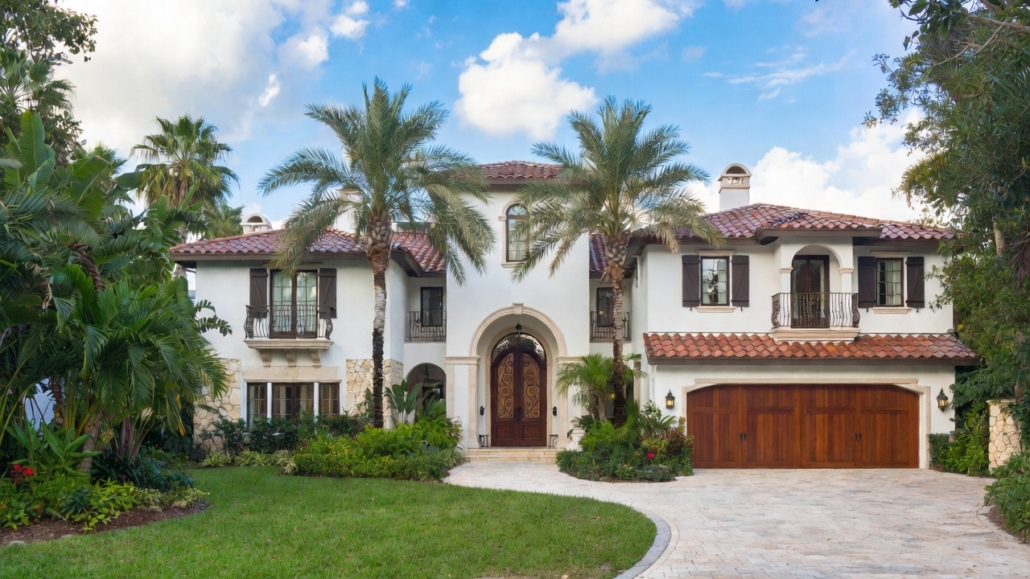
Florida Luxury Homes
Florida Luxury Homes: What Changes When You Cross the State
- Price per square foot means something different in each Florida region, so comparing a Naples house to a Ponte Vedra house on that metric will mislead you.
- East Coast pricing turns on dockage and club access more than on square footage, and bridge clearance can be worth seven figures.
- On the Gulf coast, the elevation certificate and the county’s permit history file matter more than anything on the listing sheet.
- Central Florida is the cheapest insurance and the most house per dollar in the state, and you give up the ocean to get it.
- North Florida splits in two: Jacksonville and Ponte Vedra are year-round living, while 30A homes are rental businesses that you occasionally sleep in.
Most buyers shopping Florida luxury homes across regions are running the wrong comparison. They pull four listings from four markets, divide by square footage, and pick the outlier. That works when the houses are competing for the same thing. Here, they aren’t. A $3 million house on the Butler Chain in Windermere and a $3 million house on 30A are not two versions of the same purchase, they are two different businesses with different risk profiles and different exit conditions.
So here is the regional version, including the parts that decide whether the deal ages well.
East Coast luxury homes
The Atlantic corridor runs Miami to Amelia Island, and the real concentration of money sits between Miami Beach and the Treasure Coast.
Water drives price here, but not the way the listing photos suggest. Oceanfront is the headline number. The premium that catches people off guard is deep water dockage with direct ocean access and no fixed bridges. Two houses on the same Intracoastal canal, identical on paper, can be a million dollars apart because one can float a 70-footer out to the inlet and the other tops out at 8 feet of clearance. Get the controlling depth at mean low water and every bridge clearance between the dock and open water in writing during due diligence. This is the number one thing boat owners discover too late, and there is no fixing it after closing.
Club access is the second driver, and in the private club enclaves the house is functionally an admission ticket. John’s Island, Windsor, Admirals Cove, Royal Palm Yacht and Country Club, Sailfish Point, Loblolly. Two questions early: is membership mandatory, and is it available now. The second one gets skipped. Some of these communities run waitlists, and a waitlist does not care what you paid. I have seen buyers close on a house in a club community and then wait a season before they could use the facilities they bought the house for.
Directionally, as of mid-2026:
| Area | Character | Luxury entry |
|---|---|---|
| Miami and Miami Beach | International money, condo-dominant, highest ceiling in the state | $3M, enclaves far above |
| Palm Beach and Jupiter Island | Old money, tightly held, thin inventory | $5M on the island |
| Boca, Delray, Boynton | Country club product, lots of newer build | $1.5M |
| Stuart and Jupiter | Boating culture, quieter, strong value per dollar | $1.5M |
| Vero Beach and Indian River County | Barrier island, real privacy, no high rises | $1.5M, oceanfront well above |
That last row is my market, so weight the following accordingly.
Vero Beach is where a lot of Palm Beach and Boca buyers land once they decide they want the Atlantic without the scene. The barrier island has a three-story height limit, Ocean Drive has no chains on it, and the gated communities out here are private in practice rather than just gated at the entrance. I went through that specific tradeoff in Vero Beach vs. Palm Beach, and again from the south county angle in Boynton Beach vs. Vero Beach and Vero Beach vs. Jensen Beach. The neighborhood-level map, including John’s Island, Windsor, Orchid Island, Riomar, and the Estate Section, is in the Vero Beach communities guide.
Where I would tell you to slow down on this coast: older oceanfront condos.
Florida’s milestone inspection and reserve study requirements have been rewritten more than once since 2022, and the practical effect is that buildings which deferred maintenance for twenty years are now voting in assessments that clear six figures per unit.
If you are looking at any condo built before 2000 on this coast, read three years of board minutes and the structural integrity reserve study before you write. Not the seller’s summary of them. The documents. And confirm the current inspection deadline with the association directly, because the statutory timeline has moved and what a listing agent told a seller in 2023 may not be current.
Insurance is the other East Coast reality, and it is less catastrophic than the national coverage implies if the house is right. Newer roof, impact glass, correct wind mitigation paperwork, and premiums are manageable. I wrote up the local storm history in more detail in does Vero Beach get a lot of hurricanes, because the honest answer is more nuanced than either side of that argument usually admits.
West Coast luxury homes
The Gulf side sells sunsets, walkable villages, and water you can actually swim in without checking the surf report.
Naples sets the ceiling. Port Royal is the top of the Florida market outside a handful of Miami islands, with Aqualane Shores, Old Naples, Coquina Sands, Bay Colony, and Grey Oaks stepping down from there. Sarasota is the cultured alternative and Bird Key, Harbor Acres, Lido Shores, and the West of Trail streets are where it lives. Then the islands: Longboat Key, Casey Key, Siesta Key, Boca Grande. Tampa and St. Pete have their own pockets in Davis Islands, Beach Park, and Snell Isle.
Two opinions, offered as opinions. Boca Grande is the most deliberately underdeveloped luxury market in the state and I think it is worth what it costs, but you need to genuinely want isolation, because there is not much there and that is the entire point. Longboat Key I am more cautious about. It is beautiful and the bridge situation means you will feel every traffic incident on the key personally. If a five mile drive turning into forty minutes would ruin your week, look at Bird Key instead.
Now the part that matters more than any of that.
After the 2022 to 2024 storm seasons, a large amount of Gulf coast inventory from Fort Myers through Tampa Bay took water. That created an exposure most out-of-state buyers have never heard of, called the 50 percent rule. If a structure in a special flood hazard area sustains damage exceeding half its market value, local floodplain rules generally require the entire structure to be brought up to current elevation standards rather than simply repaired. On a low-slab 1960s canal ranch, that means elevate or demolish. Some jurisdictions also track damage cumulatively across multiple events, which is how a house with two moderate claims ends up in substantial improvement territory.
Three documents, in this order:
- The elevation certificate. Lowest floor elevation versus base flood elevation. That gap sets both your premium and your rebuild exposure.
- The county permit history. Pull it yourself. You are looking for prior substantial damage determinations and how the jurisdiction handles cumulative damage.
- A flood quote in your name. Not the seller’s current premium. Under Risk Rating 2.0 the number does not transfer cleanly and can move significantly.
Post-2005 construction, built at or above base flood elevation with impact glass and a current roof, has come through the last few seasons fine and insures reasonably. The Gulf coast is not a bad buy. It is a market where the inspection period is where you make or lose money.
Central Florida luxury homes
This is the region that gets skipped, and it is where the most house per dollar is.
Orlando’s high end clusters tightly. Isleworth and Keene’s Pointe sit on the Butler Chain of Lakes in Windermere, which is the only inland waterfront in the state with genuine prestige and a chain you can actually run a boat on all day. Golden Oak sits inside Walt Disney World with a fee and membership structure that exists nowhere else. Lake Nona is the newer medical and tech play. Winter Park is the walkable one, brick streets, Park Avenue, lakefront on the Winter Park Chain, and it holds value better than anything else inland. Ocala, an hour northwest, is a serious horse farm market where luxury means acreage and barn quality.
I would research Bella Collina’s dues and club membership history carefully before buying there. The community has a long and public record of litigation between owners and the club over mandatory membership obligations. It may well be resolved to your satisfaction, and it is exactly the kind of thing you want your attorney reading rather than your agent summarizing.
The case for inland is short: no salt air eating your fixtures, materially lower windstorm premiums, most of the good neighborhoods sit outside coastal flood zones, better large new construction inventory, two international airports.
The case against is equally short. You are 60 to 90 minutes from the ocean, summer without a sea breeze is a genuinely different experience, and resale in the newer gated communities depends on the builder still selling next door at higher prices than you paid. I compared the day to day of it in Vero Beach vs. Orlando. A fair number of my clients solve it by doing both, inland primary and coastal second home, which is its own set of decisions I laid out in the Florida vacation home guide.
Northern Florida luxury homes
Two markets sharing a latitude and almost nothing else.
Northeast runs Amelia Island through Jacksonville down to Ponte Vedra and St. Augustine. Ponte Vedra is the center of it, with Old Ponte Vedra, The Plantation, and Marsh Landing, plus a golf culture that runs deeper than anywhere else in the state. Jacksonville has something rare in Florida, which is actual historic housing stock: Ortega, Avondale, San Marco, Epping Forest on the St. Johns, then Deerwood and Glen Kernan inland. Amelia Island is the quiet one. St. Augustine sells history and is thin on true luxury inventory.
You get seasons up here. Real ones, with winter nights in the 40s and a fall that means something. Taxes and insurance both tend to run under South Florida, and you are closer to the rest of the country. The tradeoff is that you will heat a pool if you want to swim in January.
Northwest is the Panhandle, and 30A operates as its own economy. Alys Beach, Rosemary Beach, WaterColor, Seaside, WaterSound. Gulf front price per foot up there competes with Naples, which surprises people every time.
The thing to internalize about 30A is that most of this inventory is an income business. Underwriting assumes rental revenue, which changes the entire analysis:
- Two to three years of actual rental statements, not a listing agent’s projection.
- Short-term rental rules for that specific jurisdiction and that specific HOA, confirmed in writing, since they differ town to town and have changed before.
- The management fee structure, because 20 to 30 percent of gross reshapes your return.
- Seasonality, which is severe. March through Labor Day carries the year. If you picture using this house yourself for six months, understand that 30A in January is quiet in a way South Florida’s snowbird season is not.
For an appreciating asset that mostly pays for itself and hosts your family three weeks a summer, it is one of the better plays in Florida. For a place to actually live, look northeast instead.
The five things that decide it, in every region
Roof age and material, because carriers decide on that before they look at anything else. Wind mitigation report, which is cheap and can cut a premium meaningfully. Flood zone and elevation, which is not purely coastal since inland Central Florida floods too. HOA and club financials including reserves, pending assessments, and whether membership is mandatory, transferable, and available today.
Then the one that blindsides more buyers than the other four combined: your tax bill is not the seller’s tax bill.
Florida’s Save Our Homes cap protected them, not you. Your first full year gets assessed off your purchase price. Homestead caps future increases at 3 percent, non-homestead at 10 percent on non-school levies only, which means a second home’s school portion has no cap at all. If you are moving within Florida, portability can carry a meaningful chunk of your existing benefit with you, and it is worth having your accountant model it before you pick a county.
Two more slots worth filling if you want this to read as unmistakably yours:
If the Treasure Coast is on your list
I work Vero Beach, Sebastian, Indian River Shores, Orchid, John’s Island, and Fort Pierce. If that stretch is one of your four, I can tell you which communities match what you are describing and which ones will annoy you within a year. I will also tell you when the answer is a different market, because sending someone to Ponte Vedra who should be in Ponte Vedra costs me one commission and earns me a referral.
Get in touch, or call or text (772) 999-4457. If you want to see how I handle marketing on the listing side first, that is on the homepage.


Leave a Reply
Want to join the discussion?Feel free to contribute!