
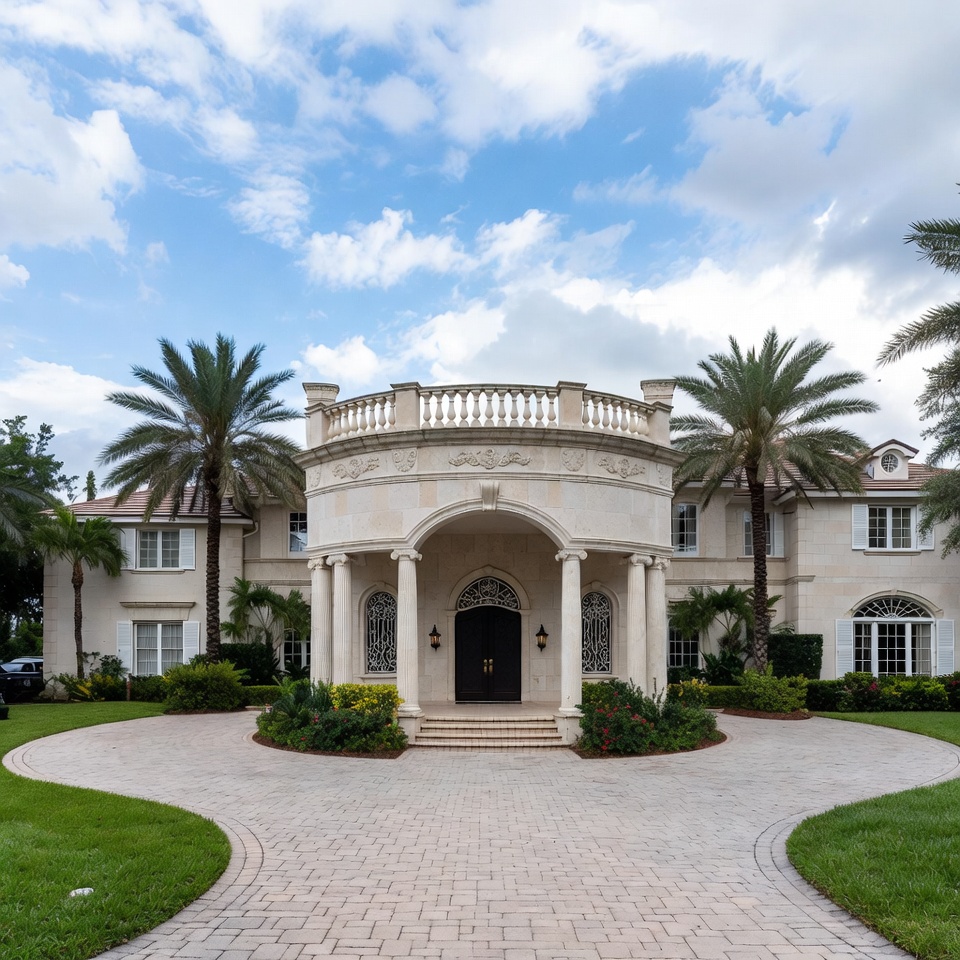
What Is Considered A Mansion?
Overview of what is considered a mansion
- There is no legal definition of a mansion. Most agents work from a square footage floor of around 5,000 square feet, though plenty now reserve the word for homes north of 7,000 to 8,000.
- Size alone does not make a mansion. It needs the luxury finishes, the amenities, and usually the land to back it up.
- A McMansion is a big house that skips the quality and the lot, so it reads as size without substance.
- The term is relative to location. A 4,000 square foot home reads very differently in Manhattan than it does on the Vero Beach barrier island.
- In Vero Beach, the homes that actually earn the label sit on the island in places like John’s Island, Orchid Island, and Windsor.
Buyers ask me this more often than you would think. Someone tours a 6,000 square foot home with a pool and a guest house and wants to know if they just bought a mansion, or if the word is reserved for something grander. The honest answer is that nobody owns the definition. There is no building code, no tax form, and no MLS checkbox that turns a big house into a mansion. That does not make the word meaningless, though. After selling real estate on three continents, I can tell you there is a rough consensus most agents work from, and it is worth understanding whether you are buying, selling, or just curious about that big house down the street.
The square footage everyone argues about
If you want a number, here is the one most people land on. Historically, 5,000 square feet was the line. A home that size was roughly double the average American house, so it stood out as something special.
The problem is that houses keep getting bigger. The typical American home runs around 2,000 square feet, and even new construction usually lands under 2,800. As the baseline crept up, so did the bar for what feels truly large. That is why a lot of agents now use 7,000 to 8,000 square feet as the real threshold, and in some high-end markets the number climbs well past that.
So the practical answer is a range. Somewhere between 5,000 and 8,000 square feet is where most people start calling a home a mansion, with the exact line depending heavily on where the house sits. For perspective, the White House is about 55,000 square feet, and it does not even crack the list of the largest private residences in the country.
Size is the entry fee, not the whole ticket
Square footage gets you in the conversation. It does not finish it. A 6,000 square foot home built with builder-grade everything is just a big house. A mansion carries a level of quality and design that a large floor plan alone cannot fake.
When I walk a buyer through a home that genuinely qualifies, the size is almost the least interesting part. What sets it apart is the rest of the package:
- High-end materials and finishes. Think stone and real wood over laminate, custom millwork, imported tile, and fixtures that were specified rather than picked off a shelf.
- Purpose-built rooms. A true mansion has spaces designed for specific uses. A home theater, a wine room, a gym, a real library, a catering kitchen behind the main kitchen.
- Amenities that go beyond the house. Pools, summer kitchens, guest houses, and on larger estates, things like tennis courts or boat docks.
- Land. A mansion almost always sits on a lot that gives it room to breathe. A huge house crammed onto a small parcel does not read the same way.
A home can be enormous and still feel light on all of this. That is the difference between a big house and a mansion.
Mansion vs. McMansion
This is the distinction that trips people up, and it matters if you are spending real money.
A McMansion has the square footage of a mansion without the substance. These homes are usually built out of proportion to their lots, pushing right up to the property line, and they lean on showy entryways and oversized garages instead of genuine craftsmanship. The materials tend to be cheaper, the architecture tends to be generic, and the whole thing often ages faster than a well-built home half its size.
You can love a McMansion for the space and the price. Just go in with your eyes open about what you are buying. When I represent a buyer at this size, a big part of the job is pointing out where the money actually went, because the listing photos will never tell you that on their own. If you want a sense of how to read pricing on a larger home before you make an offer, my reasonable offer chart walks through how to think about it.
Why the number depends entirely on where you are
Location does more to define a mansion than any single square footage figure.
In New York City, a 2,000 square foot townhouse or penthouse can absolutely carry the label, because space there is scarce and expensive. In parts of California, agents would not call anything under 20,000 square feet a mansion, and the word itself has fallen out of fashion in a lot of luxury circles. Out in ranch country, a mansion might come with hundreds of acres attached.
The useful rule of thumb is relativity. A home is often treated as a mansion when it is three to four times the size of the typical house around it, even if that number would look ordinary somewhere else. So the same 5,000 square foot home can be a clear mansion in one zip code and just a nice big house in another.
What counts as a mansion in Vero Beach
Here on the Treasure Coast, the mansions cluster where you would expect, which is the barrier island. The strip between the Indian River Lagoon and the Atlantic is where Vero’s trophy addresses live, and where prices climb fast.
If you are shopping at this level, you are looking at communities like John’s Island, Orchid Island, Windsor, The Moorings, and Riomar. These are gated and club communities where the homes have the size, the finishes, and the oceanfront or golf-frontage land that the word implies. I break all of them down in my guide to Vero Beach communities, sorted by lifestyle rather than by prestige ranking.
Cross the bridge to the mainland and the math changes. Gated golf communities like Grand Harbor deliver large, well-built homes with resort amenities, often at a meaningful discount to the island. Whether you call one of those a mansion depends on the home, but the value proposition is strong, which is exactly why so many relocating buyers land there. And it does not hurt that Florida has no state income tax, which changes the calculus for anyone moving down from the north. If that is you, start with my complete Vero Beach relocation guide.
Should you call your home a mansion when you sell it?
Probably not, and this surprises sellers every time.
Most agents avoid the word in listings, for two reasons. First, since there is no firm definition, the term promises something it cannot reliably deliver, and a buyer who shows up expecting a mansion and finds a large house is a disappointed buyer. Second, at this price point, the word can come across as trying too hard. Buyers shopping for an eight figure island estate are not looking for the listing that shouts “mansion” in the headline.
The exception is a home with genuine history, where the word is part of the property’s actual identity. Outside of that, you are usually better off letting the photos, the square footage, and the features do the talking. That is the approach I take with every high-end listing, and it works.
Thinking about buying or selling a larger home in Vero Beach?
Whether you are trying to figure out if a property is truly a mansion or just a big house, or you want to know what your own home should really be called when you list it, that is the kind of thing I sort out for clients all the time. Tell me your budget, your must-haves, and whether you are full time or seasonal, and I will send you what actually fits. Get in touch here or call (772) 999-4457.
Related reading


Leave a Reply
Want to join the discussion?Feel free to contribute!